

Why Your Steam Iron is “Acting Out”
We’ve all been there: you’re mid-press on a crisp white shirt when your iron suddenly spits a brown, watery mess. It’s frustrating, but it’s actually a predictable chemical process.
Over time, the minerals in your tap water (like calcium and magnesium) undergo “thermal decomposition.” Basically, the heat turns liquid minerals into solid “scale” that clogs your vents and insulates the heating element. According to engineering experts, untreated scale can reduce your iron’s heat efficiency by up to %!
The good news? You don’t need a new iron. You just need to master the “Aqueous Chemistry” of a deep clean.
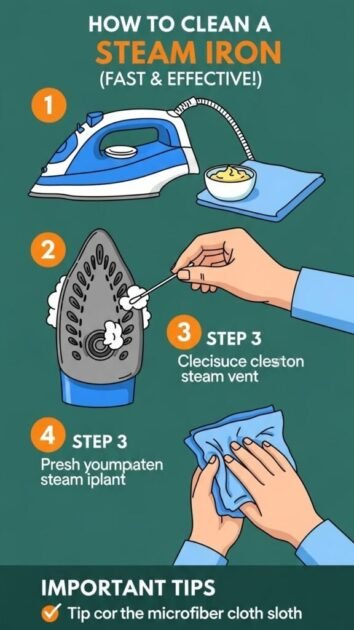
Step : The Vinegar Descaling “First-Line” Treatment
White distilled vinegar is the “viral” hero of the laundry room for a reason. Its % acetic acid content is the perfect mild solvent to dissolve calcium carbonate without damaging your iron’s internal seals.
The Protocol:
The Mix: Create a : solution of white vinegar and distilled water. Fill the reservoir about one-third full.
The Mix: Create a : solution of white vinegar and distilled water. Fill the reservoir about one-third full.
The Heat: Turn your iron to the highest steam setting.
The Heat: Turn your iron to the highest steam setting.
The Steam: Iron an old towel or rag for – minutes, frequently using the “steam burst” button to flush out the loosened white flakes.
The Steam: Iron an old towel or rag for – minutes, frequently using the “steam burst” button to flush out the loosened white flakes.
The Flush: Empty the reservoir and run one final cycle with pure distilled water to remove any lingering vinegar scent.
The Flush: Empty the reservoir and run one final cycle with pure distilled water to remove any lingering vinegar scent.
Step : Restore the “Glide” to Your Soleplate
Whether you have a durable stainless steel base or a delicate ceramic coating, the surface of your iron accumulates “carbonized residue”—basically burnt starch and synthetic fibers.
For Stainless Steel: You can be a bit more aggressive. A paste of baking soda and water works wonders to gently scrub away dark spots.
For Non-Stick/Ceramic: Treat these like your favorite omelet pan! Use a soft cloth dipped in a pH-neutral cleaner. Avoid harsh abrasives, which can strip the “sacrificial” non-stick layer and cause the iron to drag forever.
Step : The Secret to “Zero-Scale” Living
If you live in a hard water area, you are fighting a losing battle with the tap. Hard water (over ppm of minerals) creates a “perfect storm” inside the heating chamber.
The ultimate pro tip? Use Distilled Water. While it costs a bit more upfront, it eliminates scale formation entirely. If you prefer tap water, make sure to use your iron’s “Self-Clean” or “Anti-Calc” function at least once a month to prevent those microscopic crystals from hardening into a permanent crust.
Step : The -Minute Post-Clean Protocol
Once your iron is clean, don’t jump straight back to your silk blouse!
The Buffering Period: Let the iron sit hot for minutes after cleaning to ensure all chemical residues are evaporated.
The Buffering Period: Let the iron sit hot for minutes after cleaning to ensure all chemical residues are evaporated.
The Test Run: Always iron a scrap piece of cotton first. This catches any “last-minute” flakes that might be lurking in the vents.
The Test Run: Always iron a scrap piece of cotton first. This catches any “last-minute” flakes that might be lurking in the vents.
Troubleshooting Like a Pro
Reduced Steam? You likely have “Stage ” consolidation. Try a % citric acid solution for a stronger descaling punch.
Reduced Steam? You likely have “Stage ” consolidation. Try a % citric acid solution for a stronger descaling punch.
Brown Water? This is internal corrosion. It means the metal inside is oxidizing. A deep flush with distilled water is needed immediately to save the appliance.
Brown Water? This is internal corrosion. It means the metal inside is oxidizing. A deep flush with distilled water is needed immediately to save the appliance.
Preventative Care Calendar
After Each Use: Empty the water reservoir! Leaving water to sit leads to faster mineral precipitation.
After Each Use: Empty the water reservoir! Leaving water to sit leads to faster mineral precipitation.
Monthly: Run a quick vinegar flush if you have moderate water hardness.
Monthly: Run a quick vinegar flush if you have moderate water hardness.
Annually: Inspect the cord and gaskets for any signs of thermal wear.
Annually: Inspect the cord and gaskets for any signs of thermal wear.
Mastering the science of your steam iron doesn’t just save you $ on a new appliance—it ensures your wardrobe stays looking sharp and streak-free for years to reach!
Ready to tackle the rest of the house?
Read more: [The Science of Kitchen Hygiene: A Comprehensive Approach to Culinary Cleanliness]
What’s the most frustrating thing about your current laundry routine—is it the iron, the folding, or the stubborn stains?