















Your kitchen isn’t just a cooking space—it’s a complex microbial ecosystem where food safety, health outcomes, and household wellness intersect. While conventional cleaning advice focuses on surface-level tidiness, a deeper understanding of microbiology, contamination pathways, and evidence-based sanitation practices reveals a more sophisticated approach to maintaining a truly clean kitchen environment.
“The kitchen represents one of the most microbiologically diverse environments in the home,” explains Dr. Jennifer Quinlan, food safety specialist at Drexel University. “Understanding bacterial colonization patterns and cross-contamination dynamics allows us to implement targeted interventions that go far beyond aesthetic cleanliness to genuine pathogen control.”
Recent research from the National Sanitation Foundation (NSF) International identified kitchen items harboring significantly higher bacterial loads than commonly perceived “dirty” surfaces—with dish sponges, sink drains, and cutting boards ranking among the most contaminated household items. This evidence underscores the need for strategic, science-informed cleaning protocols rather than intuitive approaches.
Table of Contents
Key Sections:
Understanding Kitchen Microbiology: The Foundation of Effective Cleaning
The kitchen’s warm, moisture-rich environment creates ideal conditions for bacterial proliferation. Foodborne pathogens including Salmonella, E. coli, Listeria monocytogenes, and Campylobacter can establish colonies on inadequately sanitized surfaces, creating contamination reservoirs that persist between cooking sessions.
The Contamination Triangle:
Research published in the Journal of Food Protection demonstrates that effective bacterial transfer requires three elements: a contamination source (raw foods, hands, or contaminated surfaces), a transfer mechanism (direct contact, aerosol dispersion, or liquid migration), and a susceptible surface or food product. Disrupting any point in this triangle significantly reduces foodborne illness risk.
“Most home cooks vastly underestimate cross-contamination velocity,” notes Dr. Donald Schaffner, food microbiologist at Rutgers University. “Our research shows bacteria can transfer from contaminated chicken to clean lettuce in under two seconds of indirect contact through shared cutting boards—even after surface wiping.”
High-Risk Microbial Zones
NSF International’s comprehensive microbiological survey identified the following kitchen items as harboring the highest pathogen concentrations:
Understanding these concentration points allows for strategic resource allocation in cleaning efforts.
Critical Control Points: The HACCP Approach for Home Kitchens
The Hazard Analysis and Critical Control Points (HACCP) system, originally developed for commercial food operations, provides a valuable framework for home kitchen management. By identifying specific points where contamination risk peaks, we can implement targeted interventions with maximum effectiveness.
The Food Preparation Pathway
Raw Protein Handling Zone: Raw meats, poultry, and seafood introduce the highest pathogen loads into kitchen environments. Research from Kansas State University using fluorescent markers demonstrated that traditional food preparation techniques spread contamination to an average of 7.2 surfaces during a single cooking session—most without the cook’s awareness.
Evidence-Based Protocol:
Produce Processing Area: While vegetables pose lower immediate pathogen risk, soil-borne bacteria and agricultural contaminants require attention. CDC investigations trace 46% of foodborne illnesses to produce items, often through inadequate washing or cross-contamination during preparation.
Optimal Approach:
The Moisture Management Challenge
Standing water and persistent dampness create bacterial breeding grounds. Microbiological studies show bacterial populations can double every 20-30 minutes in favorable conditions.
Strategic Interventions:
Evidence-Based Cleaning Protocols: Beyond Surface Appearance
Effective kitchen sanitation requires understanding the distinction between cleaning (removing visible debris and organic matter) and sanitizing (reducing bacterial populations to safe levels). Research consistently demonstrates that cleaning alone reduces bacterial counts by approximately 80%, while proper sanitizing achieves 99.9%+ reduction.
Multi-Stage Sanitation Process
Stage 1: Physical Debris Removal Organic matter (food particles, grease, biofilm) protects bacteria from disinfectants. The CDC emphasizes that sanitizers cannot penetrate biofilm barriers effectively, making initial cleaning critical for subsequent disinfection success.
Stage 2: Targeted Disinfection After cleaning, apply EPA-registered disinfectants to high-contact surfaces. Quaternary ammonium compounds (“quats”) and sodium hypochlorite (bleach) demonstrate broad-spectrum antimicrobial activity against kitchen pathogens.
“Contact time is the most overlooked variable in home disinfection,” emphasizes Dr. Quinlan. “Most disinfectants require 3-10 minutes of wet contact with surfaces to achieve labeled kill rates, yet home users typically wipe products off within seconds, dramatically reducing effectiveness.”
Optimal Disinfection Protocol:
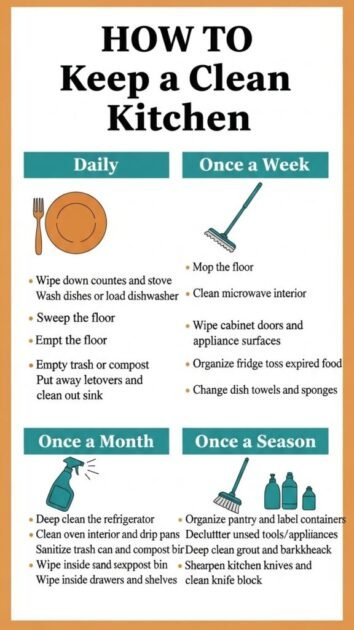
Stage 3: Systematic Maintenance Daily attention to critical areas prevents bacterial colonization that requires intensive remediation.
Daily Tasks (5-10 minutes):
Weekly Deep Cleaning (30-45 minutes):
Monthly Intensive Protocols:
Material Science Considerations: Surface-Specific Strategies
Different materials harbor and release microorganisms at varying rates. Understanding these properties informs targeted cleaning approaches.
Countertop Materials
Non-Porous Surfaces (Stainless Steel, Quartz, Solid Surface): These materials resist bacterial absorption, allowing effective surface disinfection. Studies show bacteria survive less than 48 hours on stainless steel with proper cleaning.
Care Protocol: Hot soapy water followed by disinfectant spray; achieves near-complete sanitization with proper technique.
Porous Surfaces (Wood, Granite, Marble): Natural stone and wood absorb liquids, allowing bacteria to colonize subsurface regions beyond disinfectant reach. Research from the University of Wisconsin found that wooden cutting boards harbor bacteria in knife grooves and grain structures.
Enhanced Protocol:
Sink and Drain Systems
Kitchen sinks rank among the most contaminated household surfaces—NSF research detected coliform bacteria in 45% of kitchen sinks tested, with food particles in drain traps creating persistent biofilm colonization.
Comprehensive Sink Sanitation:
“Biofilm formation in drain systems is remarkably resilient,” Dr. Schaffner notes. “Once established, bacterial communities become 1000 times more resistant to disinfectants than free-floating cells. Prevention through regular maintenance is vastly more effective than remediation.”

Tools and Equipment: Maximizing Cleaning Effectiveness
The implements used for cleaning significantly impact outcome quality. Research-backed tool selection enhances both efficiency and microbial reduction.
Optimal Cleaning Tools
Microfiber Cloths: Swedish research demonstrates microfiber removes 99% of surface bacteria compared to 30-40% for cotton cloths. The microscopic fiber structure mechanically captures microorganisms rather than simply redistributing them.
Application: Use color-coded microfiber cloths for different zones (red for raw protein areas, green for produce, blue for general surfaces) to prevent cross-contamination.
Disposable Options: For highest-risk situations (raw poultry preparation, cleaning after illness), disposable paper towels eliminate cross-contamination risk entirely. While less environmentally sustainable, they provide maximum safety for specific applications.
Scrub Brushes: Brushes with stiff bristles effectively disrupt biofilm and reach textured surface areas. Designate separate brushes for dishes, produce, and surface cleaning.
Maintenance: Sanitize brushes weekly in dishwasher or bleach solution; replace every 2-3 months.
The Dish Sponge Dilemma
Despite ubiquity, traditional cellulose sponges represent significant contamination vectors. German research identified 362 different bacterial species in used kitchen sponges, with bacterial densities reaching 5.4 × 10¹⁰ cells per cubic centimeter—comparable to fecal matter.
Alternatives Ranked by Safety:
Behavioral Patterns for Sustained Hygiene
Even optimal protocols fail without consistent implementation. Behavioral science research identifies strategies for building sustainable cleaning habits.
The Habit Loop Framework
Dr. BJ Fogg’s Tiny Habits research demonstrates that successful behavioral change requires: a clear trigger, simplified action, and immediate positive reinforcement.
Kitchen Application:
Environmental Design
Physical space organization dramatically influences cleaning consistency. Research shows clutter reduction decreases cleaning time by 40% while improving thoroughness.
Optimization Strategies:
The “Clean as You Cook” Methodology
Professional kitchens employ continuous cleaning during food preparation rather than post-meal cleanup sessions. This approach prevents dried food debris (requiring more intensive cleaning) and reduces cross-contamination windows.
Implementation:
Specialized Considerations: Appliance-Specific Protocols
Modern kitchens contain complex appliances requiring targeted maintenance approaches.
Refrigerator Microbiology
Refrigeration slows but doesn’t eliminate bacterial growth. Research from the University of Georgia found Listeria in 14% of home refrigerators tested—concerning given this pathogen’s cold-temperature tolerance.
Comprehensive Refrigerator Protocol:
Dishwasher Optimization
Modern dishwashers achieve superior sanitization compared to handwashing—research shows water temperatures above 140°F (60°C) combined with detergent chemicals reduce bacterial loads by 99.999%.
Maximizing Effectiveness:
Integrating Food Safety Science: Beyond Surface Cleaning
True kitchen hygiene extends beyond visible cleanliness to encompass food handling practices that prevent contamination introduction.
Temperature Management
The “Danger Zone” (40-140°F/4-60°C) allows rapid bacterial multiplication. USDA research shows bacteria can double every 20 minutes in this range.
Critical Practices:
Personal Hygiene Integration
Hand hygiene represents the most critical food safety intervention. CDC analysis attributes 40% of foodborne illness outbreaks to contaminated hands.
Optimal Handwashing Protocol:
Critical Timing:
When Professional Intervention Is Warranted
Certain situations exceed home remediation capabilities and require professional assessment.
Red Flags Requiring Expert Evaluation:
Professional cleaning services employ commercial-grade equipment and EPA-registered sanitizers not available to consumers, achieving sanitization levels appropriate for compromised situations.
Conclusion: A Systems-Based Approach to Kitchen Hygiene
Maintaining a genuinely clean kitchen transcends surface aesthetics to embrace evidence-based microbiology, strategic protocol development, and sustainable behavioral patterns. By understanding bacterial contamination dynamics, implementing targeted sanitation measures, and building consistent maintenance routines, you create a kitchen environment that protects household health while supporting culinary creativity.
“The most effective kitchen hygiene programs are those that become invisible through habituation,” Dr. Quinlan reflects. “When evidence-based practices become automatic behaviors, safety and cleanliness emerge naturally from daily routines rather than requiring constant conscious effort.”
The investment in understanding these principles and implementing systematic protocols pays dividends in reduced foodborne illness risk, extended appliance lifespan, and the peace of mind that comes from knowing your culinary space meets the highest standards of cleanliness and safety.
References and Further Learning
Note: This article provides educational information based on current food safety research. Individual kitchen situations may require specialized assessment. Consult food safety professionals for specific concerns or unusual circumstances.
Read more: Mastering Indoor Plant Watering: The Science-Based Approach to Thriving Houseplants